100 WORD BOOK REVIEWS / Knock-Off Monarch by Crystal Stone

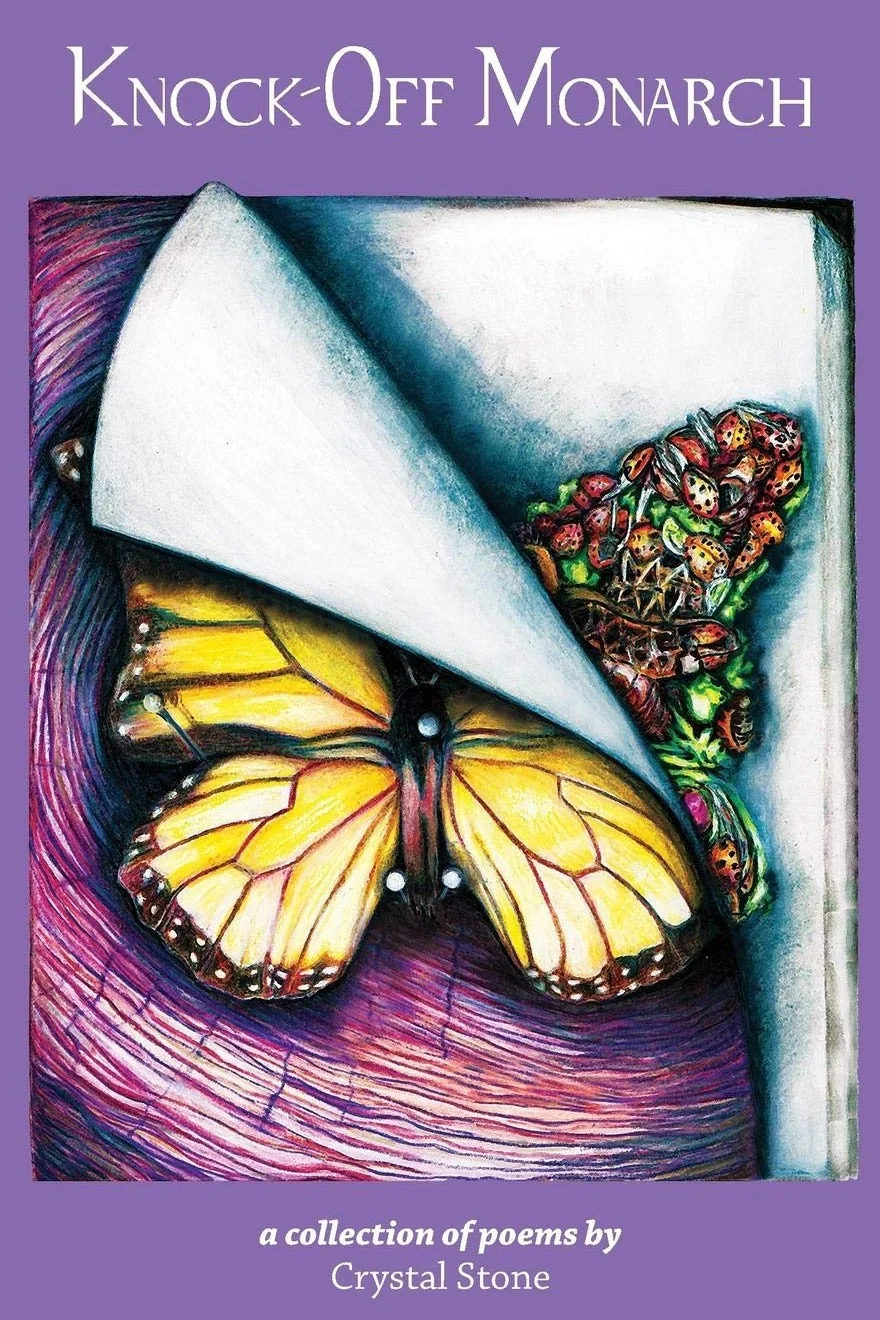
You don’t want to be trite, and simply say Crystal Stone covers substantial ground—a mother’s death, poverty, addiction, Christianity, coming of age—with a surprisingly light hand and impressive formal range; included are prose poems, found poems, concrete poems, list poems, among others. Stone handles both form and subject matter with careful attention. Her poems are observant, descriptive, and evocative: “I’ll teach ‘em how to cook daddy’s squirrel potpie,/ rub pork ribs the right way,/mash potatoes like a man and baconwrap their vegetables tight.” The wry, frank voice is what pulls all of these poems together, what the person watching you on the train must sound like.
Kim Jacobs-Beck, Contributor

Kristin Garth’s novel, The Meadow (Alien Buddha Press), builds upon her autobiographical poetry collection of the same name. Make no mistake: The Meadow’s not salacious BDSM Twilight fan fic marketed toward mass audiences. What’s key to understanding this work is the humanity with which Garth imbues her young protagonist, Scarlet. As Scarlet explores her sexuality through lurid encounters with various characters, the reader cannot help but simultaneously sympathize and empathize with her as she attempts to reach catharsis. Furthermore, Garth paints this niche community with respect, while also fairly criticizing certain aspects of it. Readers wanting sole titillation look elsewhere.

Kim Vodicka’s (The Elvis Machine) latest poetry collection, Dear Ted, is a tsunami of words—simultaneously destroying with feminine rage and empowerment the male shitstorm women deal with every day while also honoring women survivors and those who deserve to be remembered. Mixing popular culture and open discussions of sexuality, Dear Ted eviscerates Ted Bundy and other serial killer/stalker/dater-esque men. Reading her poems becomes an act of complicity as each word or image slices male entitlement to ribbons. Even in the rare moments where the metaphorical knife briefly dulls, Vodicka’s poetic onslaught remains a continuous bloodletting experience.

If Under Your Skin is any indication of things, Matthew Standiford is a horror writer you’re going to want to keep an eye on. In his story of a young man whose bleak day-to-day life takes a surreal turn into the brutality that’s possible when you don’t have anything else to turn to. Without making his characters seem overly sympathetic, Standiford takes main character Brandon’s search for girls whose skin can be of use to his ailing, damaged girlfriend Jennifer, and tells a deeply effecting story. It’s a particularly twisted mediation on redemption and accountability, making Under Your Skin is a must-read for genre fans.

Dumb Dumb Dumb: My Mother’s Book Reviews is MST3K alumni and celebrated humorist/comedian Mary Jo Pehl at her very best. The book essentially functions as a memoir, looking back at Pehl’s relationship to her extraordinary mother. A fascinating woman and voracious, informed reader of more books than most human minds can conceive, Pehl creates a portrait of her mother as someone who you sincerely wish you could meet for yourself. Pehl’s writing here is as detailed as it is hilarious. She has always had the incredible talent for making us laugh amidst a vivid depiction of the everyday. That has never been more apparent than it is here.

Linnet Phoenix’s distinctive, deceptively soft works run an intriguing gamut of styles in Rusty Stars, available now from Between Shadows Press. Some of these poems are written as though each word needed to go deeper than the page and planet, with how pointedly they must have put to that page. Others are a hectic spill of metaphor and vital word choice. The manic tone of some of these pieces run next to the more reserved poems in a race that could honestly go on forever. No, maybe not forever; but this is still a collection I won’t forget anytime soon.

“61/49” and “Heart of the Heartland” are two brilliant examples of the storytelling Dan Wright has in mind for Love Letters from the Underground, available now from Spartan Press. Dan’s poetry is well-constructed, because there is clearly an understanding of form, combined with the ability to manipulate the form to give these stories further layers. However, it is in the remarkable care for his subjects, particularly in their relationship to the often-unhappy world around them, where Wright leaves us with poems and narratives that are truly born out of the frustration or even anguish of the forgotten.

One of the most appealing things about the richly illustrated, instantly likable An A to Z of Elvis, written with an attention to staying off the beaten path by Joe Shooman, is that you don’t have to really like Elvis Presley to enjoy this book. It would probably enhance your enjoyment of the book, which takes an alphabetical trip through Elvis basics, but also deviates frequently into the many cultural connections and threads with one relation to Elvis or another. However, I think anyone who simply appreciates the butterfly effect one human being can have on history can enjoy this.

“Retrowave pulp thriller” is in the Goodreads description of this phenomenal, visceral book about sex workers, queer love, family and the unfathomable cruelty and weirdness of 1980s Los Angeles. I think that’s accurate in the most appealing fashion possible. Combining the best noir qualities with the kind of revenge drama not seen since Ms. 45, Hooker is one of the most exciting stories to come from that pulp tradition in quite some time. Sylvia Lumen makes for an impressive hero, and M Lopes da Silva gets some pretty cool ideas from the serial killer trope. Don’t miss this one.

“Our author is versed in the intersection of text and dance” reads a line from the website created to celebrate the release of Rodney A. Brown’s wonderful new book Typescenes. The book is twenty-five prose poems that you can theoretically dance to. While I can’t dance myself, there is something very musical, very singular about the way Brown seeks out a unique point where music and the lyrical written word explores the difficult, painful smaller stories that make up the larger notion of what it is to be a Black male in America. Brown offers one of the most engaging approaches to telling such stories I have ever encountered.

Probably not by design, but the work, humor, and depth of wonder and wisdom inherent in the work of Kenning Jean-Paul Garcia sometimes has the capacity to make me feel small. I’ll read something like DAWN, a wonderous, beautifully-crafted chapbook. I will love every word, every page. In the specific case of DAWN, I will read and re-read a soft, delirious dialog between two characters (I think?). However, I will also wonder just what I’m missing out there in the world. Kenning Jean-Paul Garcia has a vision and mode of embracing ideas that is apparent in every single thing he writes.